Dramatis Personae


Many-Headed Multitude
[+/-] academic blogs
[+/-] other blogs we like


Our Ongoing Series

In Sad Conference
... live reports from the field
[+/-] RSA 2008
[+/-] SAA 2008
[+/-] MLA 2007
[+/-] SAA 2007
[+/-] RSA 2007
[+/-] MLA 2006
[+/-] SAA 2006
[+/-] RSA 2006


Read On This Book
... our occasional reading group
About the reading group
[+/-] Inkhorn reads the Anatomy [+/-] FS Boas, University Drama [+/-] D. Shuger, Political Theologies


The Motto Thus
... our silly woodcut caption contest
[+/-] Past Contests


More Foolery Yet
... which we write periodically
[+/-] Holzknecht Redivivus
[+/-] EEBOnics
[+/-] Notes and Queries

Sunday, April 30, 2006

British History Online

Via Natalie Bennett at Philobiblon:
British History Online has got a further tranche of money from the Andrew W Mellon Foundation. From an email source (doesn’t seem to be online):

“Phase II of the project, from 1 August 2006, will see the expansion of the British History Online digital library to include the National Archives Calendars of State Papers, Domestic (1547-1704, 1760-75), a further 40 volumes of the Victoria County History and a range of sources for the social, administrative, economic and political history of Britain.”

This is an incredible site, but to date it hasn't been as good on our period as it could be. The addition of the CSP Dom for 1547-1704 will be a major improvement. Great news.

Saturday, April 29, 2006

The Roundhead's Reply?

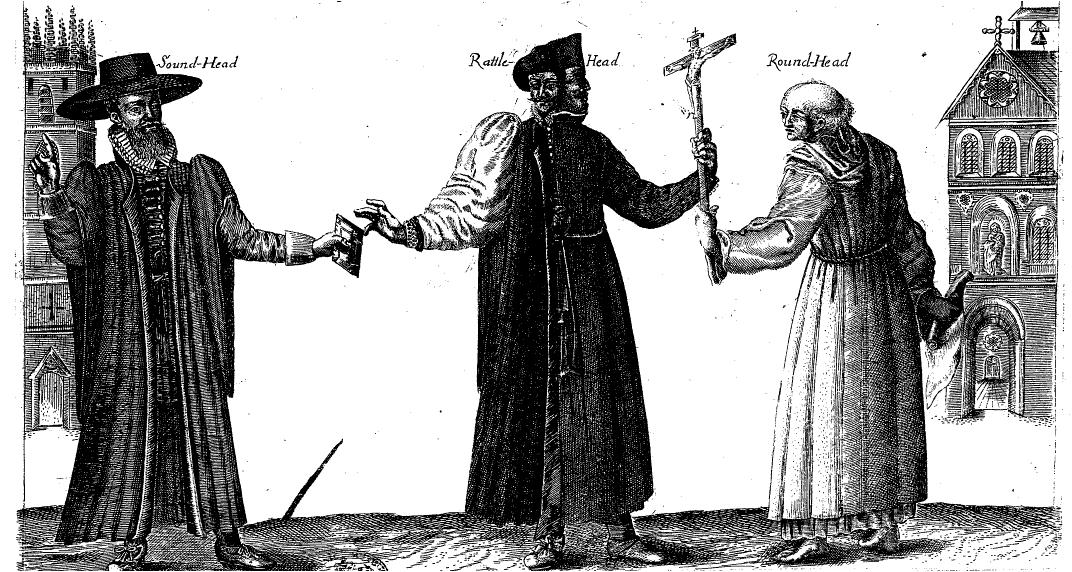
Continuing with what has apparently become our "Roundhead Period," here's a great engraving (Thomason Tracts 669.f.6[94]) from the same year, 1642, as the ballad "My Bird is a Roundhead." This satirical print, however, strikes back at those who seek to marginalize the godly as out-of-the-mainstream "puritans" and "roundheads." Instead, the print asserts, those who hurl these epithets are themselves "athiests" and "Arminians," or even crypto-Catholics. The print shows three men: a Sound-head (left), a Rattle-head (center), and a Round-head (right):


click to enlarge

Beneath the Sound-head (who wears what seems to be a "puritan" hat but whose costume does not seem otherwise particularly "puritan") are these verses:
This Foolish World is full of foule mistakes,
Calls Virtue, Vice; & Goodnes Badnes makes,
The Orthodox, Sound & Religious Man,
Atheists call Round-Head (late) a Puritan:
Because Hee (roundly) Rattle-Heads, Truths foes,
Plainly depaints. As this next figure showes.
According to ESTC, the Rattle-Head--so-called because his two-faced head rattles from one side to the other--depicts a composite of Robert Philips, the Queen's confessor, and Archbishop Laud. He is in the process of turning from the English to the Roman Church, taking the Bible from the godly Sound-Head in one hand and transforming it into the crucifix he gives the Round-Head with his other hand. Laud, the story goes, was offered a cardinal's hat by the Pope: his defenders pointed out that he refused it; to his critics, the point was that he was offered it. The verses beneath him read:
See, heer, the Rattle-Heads most Rotten-Heart,
Acting the Atheists or Arminians part;
Vnder One Cater-cap or Ianus-face,
Rejecting Truth, a Crucifixe t'embrace:
Thus Linsey-Wolsie, Priestly-Prelates vile,
With Romish-rubbish did mens Soules beguile.
Finally, the Round-Head image shows the godly appropriation of the pejorative epithet, turning it back on anti-puritans, who are revealed as Catholic sympathizers, if not Catholics themselves:
But heer's a Round-Head to the purpose shown,
A Romish-Rounded-Shavling, too well known;
A Balld-pate Fryer a Round-Head indeed,
Which doth (almost) Rotunditie exceed:
Since These Round-Heads, with Rattle-Heads so 'gree,
Romish Malignants Round-Heads right may be.
The engraving, combined with the ballad discussed earlier, nicely shows how the idea of orthodoxy itself became a battleground, with each side claiming to represent the mainstream of English Protestantism. And it shows how the battle was waged in the popular press, through images and through poetry.

Notes:
  • cater-cap] the square cap worn by academics; hence, I think this is an early sort of David Horowitzian attack on "elitist" university men, whose overly curious studies have led them theologically astray. So, actually, this print gives a small answer to Simplicius's request for a post about the politics of headwar in the Civil War period: the Sound-Head's godly hat; the Rattle-Head's academic catercap; and the shaveling friar's pate.
  • Linsey-Wolsie] ie, linsey-woolsey. Like Janus-faced, this refers to the Rattle-Head's two-faced hypocrisy, since linsey-woolsey is a fabric woven from a mixture of wool and flax.
  • Priestly-Prelates ... Romish-Rubbish] I like the alliteration here, which nicely conveys the Rattle-Head's back-and-forth duality.
  • Which doth (almost) Rotunditie exceed] This line is hilarious.

Friday, April 28, 2006

Thomas Nashe, Roundhead

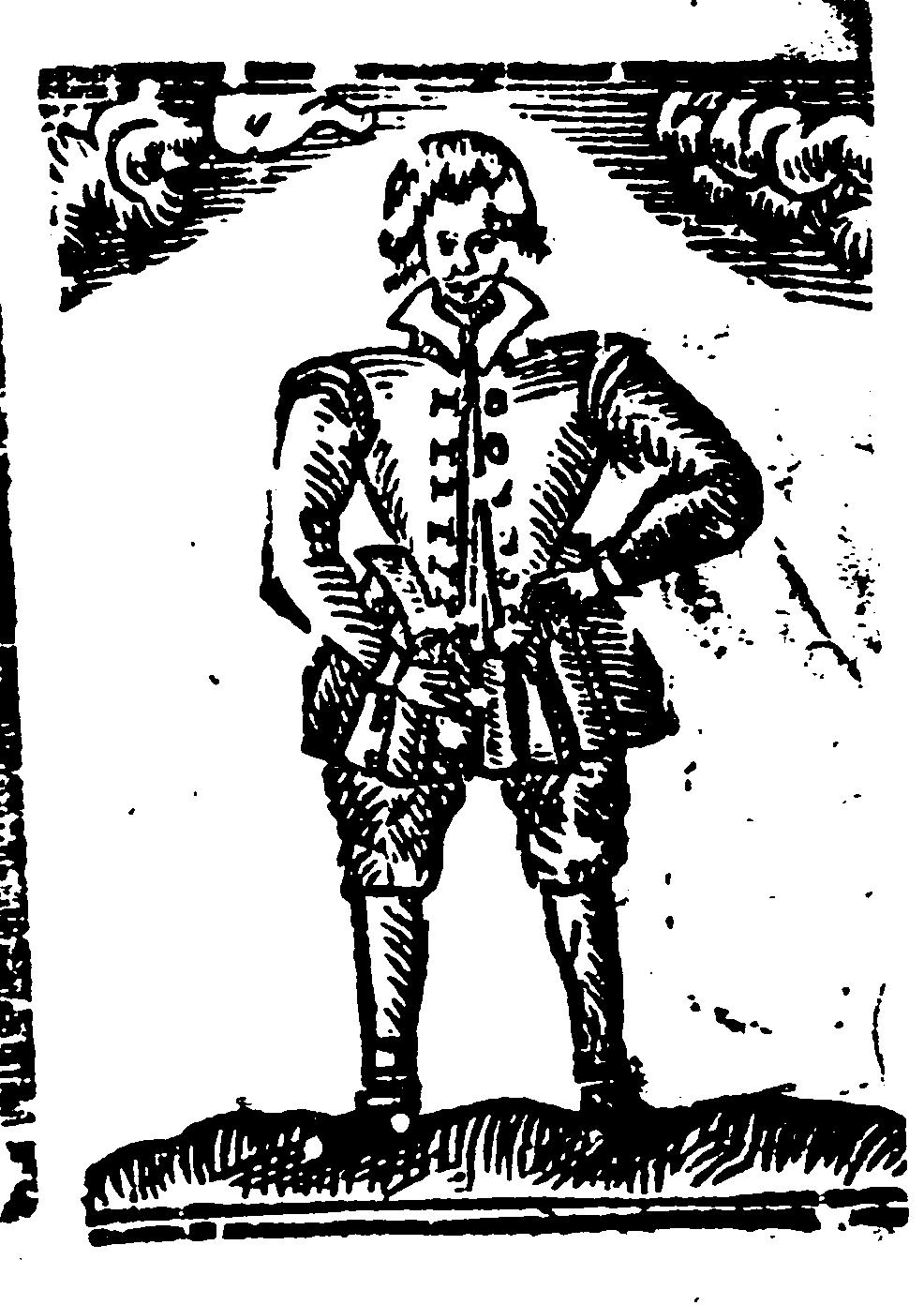
Inkhorn has truly lived up to his name this time. In his comments on "My Bird is a Round-head," which I wrote contained a "stock woodcut" of a man on its right-hand side to represent (presumably) the puritan in the ballad and to save the publisher the cost of a custom-made woodcut, Inkhorn wrote (in part): "That woodcut of the man isn't quite so general: I think it's Thomas Nashe. Or, the woodcut was used to represent Thomas Nashe in a 1597 pamphlet called, The Trimming of Thomas Nashe."

Here's the woodcut from the 1642 ballad again (Wing C7285B):

And here's the woodcut on sig. E2r of The trimming of Thomas Nashe Gentleman, by the high-tituled patron Don Richardo de Medico campo, barber chirurgion to Trinitie Colledge in Cambridge (1597, STC 12906), probably by Gabriel Harvey:

No doubt about it: that's the same woodcut, much the worse for wear over the 45-year interim. No wonder the man doesn't dress like a roundhead. And no doubt about it: that's an awfully impressive feat of the Renaissance art of memory from Inkhorn.

The Trimming was printed by Edward Allde for Philip Scarlet, while the ballad was printed for Richard Harper. ESTC does not identify a printer for the ballad. I'd bet that if one traced the fate of Allde's type stock down through the years (who inherited his printing material, and so on), we'd know who printed the ballad. And I'd be surprised if the woodcut didn't turn up periodically in other books between 1597 and 1642 (or after). Anyone want to take up that task of bibliographical sleuthing? Perhaps there's a Nashe scholar out there who already knows the afterlife of this woodcut.

As Inkhorn wrote in his comment, I'm not sure this history tells us anything about the ballad (although Inkhorn's suggestion about the Nashe/Marprelate nexus is intriguing), but at least it tells us that the man in the 1642 version is not holding what it looks like he's holding in his right hand--there's supposed to be a chain attached to leg-irons there.

An Odd Ballad: "My Bird is a Round-head"

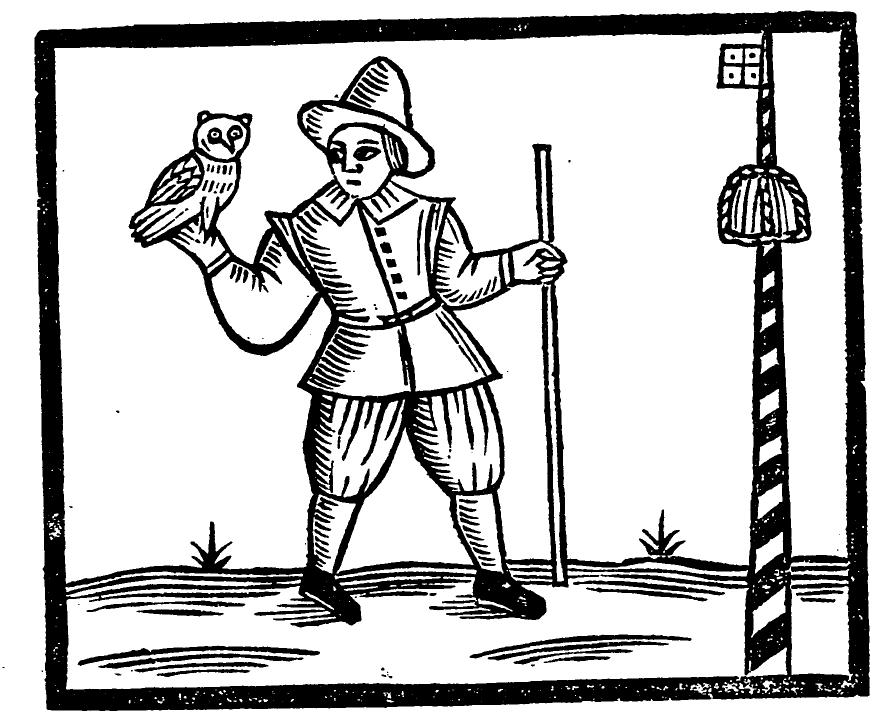
Here's a strange item I found while trolling through EEBO today for something else, and so in keeping with our EEBOnics project that Truewit founded, and following up on my earlier post about the Book of Sports, I present it here. Printed in the fateful year of 1642, the ballad, by Humphrey Crouch, is a mockery of puritans, but a truly odd one, featuring a madcap Northamptonshire man who loves "sports and pastimes" and sets up a maypole, which annoys a local puritan. When the puritan scolds him, the man's reaction is bizarre: he goes inside and gets his pet owl, whose name just happens to be Roundhead. What follows implies some sort of humor at the puritan's expense, but this segment of the tale is not exactly made crystal clear; maybe it was one of those you-had-to-be-there sectarian-bird jokes. You know the kind I mean, I'm sure. It's an interesting ballad, bird-humor aside, because of its take on those who "with mere toys do trouble [their] pates," an attempt to ridicule religious extremists for making such a fuss over trifles--and to convince others, in one of the period's most popular oral and print forms, to shun such extremes. All of which gains an added poignancy, I think, from being published in the first year of the civil war.

The ballad features a nice, custom-made woodcut on the left-hand side of the broadsheet:
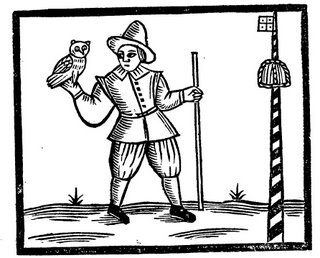
That's the maypole in the foreground, for those of you who have never danced around one. To save money, the publisher simply used stock woodcuts of a town and a man for the right-hand side (which, following customary practice, is called the "second part" even though there is no break in the narrative):
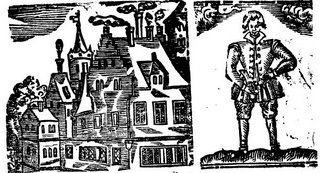
You can see that these cuts are not in as good shape as the Maypole/bird cut, no doubt having deteriorated over years of use.

Here's the ballad in its entirety, and we'll see if we can use our collective critical-historical skills to decipher the comedy. I mean, why an owl? And why exactly does the puritan bring the other man before a justice of the peace? Bird-related slander?


My Bird is a Round-head
Being a very pleasant and true Relation of a man in Northamptonshire, that kept a tame Owle in his house, whome he called Round-head; and how one of his neighbours had him before a Justice, for calling his Owle Round-head.

To the tune of, let us to the wars againe.

As I to London tooke my way,
A pretty passage caus'd me to stay,
Which you shall know if you attend,
No honest man I will offend;
You that are wise in your conceits,
That with meere toyes doe trouble your pates,
[chorus:] To whit to who, come say what you will,
My Bird she is a Round-head still.

In Northamtonshire a man did dwell,
That sports and pastimes loved well,
A May-pole he set up on hye,
To recreate all Commers by;
But one that was more nice then wise,
Was much offended and tearm'd it a vice:
[chorus]

Neithbour (quoth he) you are prophane,
I wonder you will be so vaine,
A May-pole here for to erect,
Methinkes such toyes you should reiect;
Young folke about it dance and play,
It leads their minds too much astray:
[chorus]

Ile have it downe beleeve me friend,
Although that halfe my estate I spend,
Tis but a kind of an Idoll vaine,
Against it honest men complaine;
And thus this understanding Clowne,
Did still protest to have it downe:
[chorus]

Kind neighbour quoth the other man,
How long have you beene a Puritan?
Zounds the May-pole here shall stand,
It shall not downe at your command;
Youd have it downe, I pray Sir, why?
Come show me your authority:
[chorus]

This man he had an Owle in his house,
That killed many a Rat and Mouse,
And cause he would doe what he list,
He brought her out upon his fist;
And to his neighbour shew'd her straight,
That still stood bawling at his gate:
[chorus]
The second part, to the same tune.

Neighbour, what Bird is this (quoth he)
That here upon my first you see?
Tis a Mag-howlet tother reply'd,
That on your fist doth now abide;
No, tis a Round-head on my fist,
I hope I may call my Bird what I list:
[chorus]

The man began to fret and chafe,
Whilst he with his Owle did heartily laugh,
His laughing made him almost made,
The one was merry the other sad:
My pretty Round-head hurteth none,
Among other Round-heads my Bird is one:
[chorus]

She meddles not with State affaires,
Or sets her neighbours by the eares,
No Crosse nor May-pole makes her start,
Nor can she preach in Cup or Cart;
She seekes to pull no Organs downe,
Nor on an Image casts a frowne:
[chorus]

To be reveng'd the other sought,
He cal'd him knave and all to nought,
Before a Justice he did him bring,
And told the Justice every thing;
Before the Justice they came I wis,
But all they could get of him was this,
[chorus]

Sirrah quoth the Justice hold your tongue,
Good men methinkes you should not wrong,
Sir quoth the man, nor have I yet,
Though he thinks so for want of wit;
I have a Bird he sayes she's an Owle,
But I may call her Round-head or foole:
[chorus]

The Justice knew not what to say,
But friendly bid him goe his way,
Then home he went being dismist
With his Round-head upon his fist;
I wonder men so simple be,
They can be so displea'd with me:
[chorus]

There's none my Round-head will despise,
But such as are knowne to be unwise,
Giggy-headed fooles and dolts,
Sisters and unbridled Colts;
My Round-head is a gallant Bird,
Good words to her I pray afford:
To whit to who, come say what you will,
My bird it is a Round-head still.

(Wing C7285B)

A few notes and queries:
  • subtitle: Northamptonshire] What were the religious politics in Northamptonshire at the outbreak of the civil war? I believe the county favored the parliamentary cause fairly heavily, but I'm not sure. Would the setting have immediately told contemporaries something that we need to work to recover?
  • stanza 1, line 5: wise in your own conceits] see Romans 12:16, Be of the same mind one toward another. Mind not high things, but condescend to men of low estate. Be not wise in your own conceits.
  • 6.1-2: Owle, Rat, Mouse] is there some significance to these animals? is there anything about the owl in particular that makes the balladeer choose it? or to the rat and mouse, in the context of mid-century politics and religion?
  • 6.3: cause he would do what he list] a rather poor line filler, I think.
  • 9.1-6] I like this stanza the most of the whole ballad; I actually find the combination of this list of typical puritan grievances and an owl pretty funny. The owl can't set up a cart and preach on it, nor will she get really upset about church-organs and try to destroy them. Even though she is, in the most technical of senses, a Round-head.
  • 10.3-4: Before a Justice he did him bring, / And told the Justice every thing] Ok, here's where it gets even weirder: it seems to be taken for granted that one could get a hearing before a JP on the basis of mockery involving a bird ...
  • 11.1-2] ... and the JP takes it quite seriously; I can see someone in 1642 claiming that being called a roundhead is slander, and early modern England thought a lot about slander, but the whole bird aspect?
  • 11.5-6: I have a Bird he sayes she's an Owle, / But I may call her Round-head or foole] The Maypole-loving man's winning argument: Judge, I have a pet owl, and as we all know, it's every true-born Englishman's right according to the ancient constitution to name his bird whatever he pleases, even to go so far as to name the bird Round-head or Fool. Isn't that in Magna Charta? No wonder the "Justice knew not what to say."
  • 13.3: Giggy-headed] I don't find this word or giggy alone in OED; probably a misprint for Giddy-headed. See Simplicius's comment for an explanation of this word.
  • 13.4] Sisters] Why does the owl hate sisters? I don't think I've misread the text here, though the EEBO reproduction is, as always, a bit hard to read. Fools, dolts, unbridled colts I can understand, but sisters? It's possible that it actually reads Sifters but what would that mean? People who "sift" matters of controversy too nicely and precisely?

Thursday, April 27, 2006

Take That, Aretino

The first sentence of this article, about the latest trend in campus literary magazines, contains these words: "nude photo shoot," "her fellow student editors," and "Hot Girls Reading Books." It also contains a shout-out to The Craft of Research.

I don't really know how, and if, I should try to understand this campus phenomenon, and so I'm going to shut my eyes and pretend it doesn't exist. But if English departments are looking for new ways to recruit students, literary magazines may end up being an incredibly effective advertising medium.

Wednesday, April 26, 2006

Grad Placement and the Job Market

This week I calculated my department's job placement record for recent PhDs and found that, for the years 2000-2005, about 75% of our PhDs received a tenure-track job offer within three years of getting their degree. And that figure is probably a bit low, since those graduating in 2003 and after have not yet had the full three years since degree, so I expect it will rise to about 80%. That seems awfully good to me, considering that some proportion of those who did not receive a TT job offer did not particularly want one for one reason or another, and stopped searching: a few took jobs as deans, or librarians, or left academia altogether. So that probably leaves only about 15% of all those who got PhDs from our department between 2000 and 2005 who weren't able to land a TT job despite their best efforts.

Now, ours is not a "top 10" department, though we are a good department and, in fact, are probably better than you might think from our name. Still, we aren't Harvard, Berkeley, Columbia, Penn, Yale, &c. Our grad students generally teach 2 courses a semester. And yet over that five-year span about four of every five of our PhDs got TT jobs pretty quickly after getting their degree.

I know the job market is tough, and certainly these jobs were mainly at "teaching-focused" schools (some of our PhDs prefer those jobs), but I think that some of the nightmarish talk that surrounds the job market in our profession comes from faculty at "top-tier" schools who simply don't recognize many of the jobs that are actually out there as "real" jobs. That is, when they talk about how hard it is to get "a job" these days, what they mean is "a research job of the sort that I would want." And since those faculty have disproportionately loud voices in the profession--in journals like PMLA and Profession; in training the future faculty at departments like my own; and in those periodic stories about academia in the mainstream media--that nightmarish discourse spreads. Which leaves grad students in our department with a mistaken impression of their real chances on the market, even though they are not expecting or in many cases hoping to get a job at an R1 University.

I don't know how our placement figures compare to other schools (though I'd be surprised if we were outperforming our peer institutions by very much if any). I'm not saying that 80% of all PhDs get TT jobs within three years of degree. And doing the same calculations but expanding the pool to 1995-2005 lowers our placement rate to about 65%; no doubt this is because around 2000 we got an influx of money that allowed us to expand graduate fellowships and reduce their teaching load so that most grads get a year off to write their diss.

But I'm wondering how much of the rhetoric that surrounds the job market has a hidden academic-class agenda behind it, one that basically refuses to acknowledge the vast majority of faculty positions as "jobs."

Am I way off on this?

Tuesday, April 25, 2006

Open Manslaughter and Bold Bawdry

So, ever since Simplicius' post about the New Holzknecht Project -- which I approve of deeply -- I've had to ask myself: but what can those of us who don't read so many plays do? How can we contribute?

I'm not sure this is contributing in any immediately productive way, but for today, I want to provide, for the contemplation and edification of the greater early modern blog world, a few passages from my current reading: a fifteenth-century continental romance called "Tirant lo Blanc" -- which, as I've just discovered through the magic of Google, they have apparently just made into a movie.

Somewhat endearingly, the publishers of this book insist on using a line about it from "Don Quixote" -- "I swear to you, my friend, it's the best book of its kind in the world" -- as a straightforward piece of advertising copy. The book seems to have caught Cervantes's eye for the name of one, minor character, Kyrieleison de Montalban. Perhaps a distant relative of Ricardo.

In any case, these are the passages to which I wish to direct your attention.

First: picture, at the Byzantine court, a wedding; that night, after the happily wed couple have retired to their room, a small crowd, including the emperor and various ladies and knights, assembles outside the door to hear what they can hear. I guess we all know there wasn't much privacy in the early modern period. At any rate, they hear ... nothing. Which shocks and appalls one lady-in-waiting -- unambiguously named Pleasure-of-my-life -- who calls out: "Lady bride, why are you silent? Has the battle's pain and fury ended? May you feel it in your heels! Could you not utter that delightful 'Aaah!' once more, for truly, nothing is sweeter than a maiden's cries. I can tell by your silence that our constable has shot his bolt, but much good may it do you if he fails to reload! The emperor himself is here, as he feared you were in pain."

Always good to know the emperor is listening on your wedding night. Anyway, this emperor is so amused that he promply announces that, if he weren't already married, he would instantly propose to Pleasure-of-my-life. At this point, who should show up but the empress. Pleasure-of-my-life immediately says, "Die quickly, my lady, for my lord the emperor has sworn that were he unmarried, he would propose to me. Therefore offend me no longer but die as soon as you can." The empress has a couple of things to say about that, then turns to the emperor and says, "And as for you, idiot, what do you want another wife for? Your weapon is better for slapping than stabbing, and remember: no damsel was ever killed by a slap."

This passage also includes hijinks involving five kittens, which I won't trouble you with.

So there you have "Bold Bawdry." I'm following Ascham's comments about romance, here, which get quoted a lot, but which you can also find quoted in this article by Clare Kinney.

As for open manslaughter -- well, there's a lot of it, but most of it isn't so interesting. I will leave you with what seems to me about the most ignominious death in the book. At least, so far.

Tirant has captured a proud Genoese renegade, the Duke of Andrea. The emperor reads out a sentence declaring that all renegades will be publically stripped of their titles and humiliated. And so:

"When the Duke of Andrea saw such infamy heaped upon himself and his comrades, his gallbladder burst and he choked to death on his own bile."

Monday, April 24, 2006

SAA and Easter

Everyone knows that the annual MLA conference is--year in, year out--from December 27th to December 30th. But is SAA trying to lay claim to the Easter and Passover holidays as the time for its own annual conference? This year SAA met in Philadelphia during Passover and from Holy Thursday to Easter Sunday. Next year it will meet in San Diego during the same holiday period.

I understand the difficulties of scheduling anything during the Spring, but, really, two years in a row? Is this the start of some new trend? Are Shakespeareans really that irreligious? Or has worship of the Bard really emerged as a viable alternative to these other, more established, religions?

(I should add that I'm not actually upset about this. I just find it to be an odd scheduling choice for two consecutive years.)

Sunday, April 23, 2006

The Birthdays of Shakespeare and Nabokov

We would be remiss here at Blogging the Renaissance if we didn't acknowledge that today is Shakespeare's birthday. Or at least, it's three days before the date of Shakespeare's christening, which took place on April 26, 1564, and we assume Shakespeare was probably born three days prior to his christening. Or, more specifically, today is three days before the date of Shakespeare's christening in the Julian calendar (the only calendar in use in Europe when he was born). But we now use the Gregorian calendar, so the April 23rd of 1564 (Julian, or Old Style) would, starting in 1583, have been May 3rd according to the Gregorian, or New Style, calendar. This means that when Shakespeare was celebrating his 20th birthday on April 23, 1584 (Old Style), it was May 3rd, 1584 (New Style), on much of the continent. That ten-day difference would remain in effect for the rest of his life, and it's the New Style calendar that we now use.

Why did this change come about? The reason is that the Julian calendar included 365 1/4 days each year, but this was a slight over-estimate. From 45BC, when Julius Caesar instituted this new calendar, until 1582, when Pope Gregory XIII introduced a reformed calendar, "this annual error had caused, cumulatively, a discrepancy of ten days" (C. R. Cheney, ed., A Handbook of Dates, new ed., rev. by Michael Jones [Cambridge: Cambridge UP, 2000], 17). As a result, when much of Catholic Europe switched to the Gregorian calendar in 1582, ten days were subtracted from the year: October 4th was immediately followed by October 15th that year. England, however, stuck with the Julian calendar until 1752 (Greece was the last holdout, finally switching over in 1923 [civil] and 1924 [church]). If that ten-day difference weren't confusing enough, an additional day was added to the difference separating the two calendars on January 1, 1700, and then again on January 1, 1800, and on January 1, 1900 (if any countries had still used the Julian calendar, though, an additional day would not have been added in 2000, which was designated a leap year by Pope Gregory way back in 1582).

What does all this mean: today, April 23, 2006 (New Style), would be April 10, 2006 (Old Style); conversely, April 23, 2006 (Old Style) would be May 6, 2006 (New Style). But since we don't adjust anniversaries for these leap years, we would probably mark May 3rd as Shakespeare's birthday. And, of course, for dates before 1582, we understandably don't adjust for the ten-day leap that would eventually take place following the adoption of Pope Gregory XIII's calendar. So today is Shakespeare's birthday, but it's also not.

While England switched to the Gregorian calendar in 1752, Russia did not adopt it until 1918, which brings us to today's second birthday boy, Vladimir Nabokov. He was born on April 10, 1899 (Old Style), which was April 22, 1899 (New Style), in most of the rest of the world (other Old Style calendar holdouts included, besides Russia and Greece, the Balkan states of Albania, Estonia, Livonia, Bulgaria, and Rumania). Now here's where things get even more tricky. In 1900, the difference between Old Style and New Style dates changed from 12 days to 13 days, so when Nabokov celebrated his first birthday, on April 10, 1900 (Old Style), it was April 23, 1900 (New Style), in the rest of the non-Balkan West. Explaining the dating system he uses in Speak Memory, Nabokov writes:
All dates are given in the New Style: we lagged twelve days behind the rest of the civilized world in the nineteenth century, and thirteen in the beginning of the twentieth. By the Old Style I was born on April 10, at daybreak, in the last year of the last century, and that was (if I could have been whisked across the border at once) April 22 in, say, Germany; but since all my birthdays were celebrated, with diminishing pomp, in the twentieth century, everybody, including myself, upon being shifted by revolution and expatriation from the Julian calendar to the Gregorian, used to add thirteen, instead of twelve days to the 10th of April. The error is serious. What is to be done? I find "April 23" under "birth date" in my most recent passport, which is also the birth date of Shakespeare, my nephew Vladimir Sikorski, Shirley Temple and Hazel Brown (who, moreover, shares my passport). This, then, is the problem. Calculatory ineptitude prevents me from trying to solve it.

It's true; despite his brilliance, Nabokov was not particularly good at math.

So we're left with a dating paradox worthy of the works of Shakespeare and Nabokov. The birthdays of both authors are celebrated on April 23rd. Both authors, however, were born under the Julian calendar, and under that calendar, Shakespeare was (probably) born on April 23rd and Nabokov on April 10th. If we were going to go for strict calendrical accuracy, then, either we would recognize both of their Julian birthdays or both of their Gregorian birthdays. Here's what we would be left with.

Julian
Shakespeare: April 23rd
Nabokov: April 10th

Gregorian
Shakespeare: May 3rd
Nabokov: April 22nd (even though he celebrated it on April 23rd)

Or, the two-sentence version: the Julian birthdays of Shakespeare and Nabokov were thirteen days apart (April 10th and April 23rd), but we celebrate them on the same day, today, the Gregorian April 23rd. If we were to covert their Julian birthdates to Gregorian dates, however, we would say that neither author was born today and instead claim they were born on May 3rd and April 22nd, respectively.

Thursday, April 20, 2006

Gascoigne's Noble Arte of Venerie

After noticing how many people have arrived at our blog while searching for mostly unwebbed topics like "zombiism" and "Centlivre" (I think it's safe to say that Blogging the Renaissance is the only known place on earth where these two subjects sit side by side), I've decided to set up a few flaming beacons in the night for people who might be interested in the same useless early modern texts I'm interested in. So here's the first installment in a series I (and I hope my collaborators) will call EEBOnics. Well, maybe that won't be what it's called, but you get the idea.

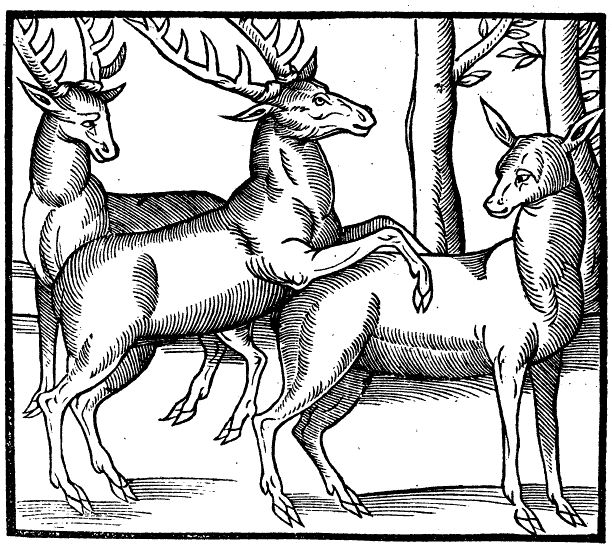
To kick things off, I thought I'd write a bit about the under-rated hunting text, The Noble Arte of Venerie (1575). First things first: it's not by George Turberville. EEBO makes this completely obvious, but since TNAV is often bound together with Turberville's hawking treatise, there's a loooong tradition of attributing it to Turberville, a tradition which has led to many a woodcut reproduction with the wrong name under it. The main body of the text is a translation of a French manual written by Jacques du Fouilloux, about whom I know nothing. But we all know something about the translator and expander of TNAV, George Gascoigne. What is there not to like about G.G.? Singlehandedly responsible for Englishing Italian comedy. Puts the plain into plain style. We say "a hundred," he says "A hundreth." That alone gets high marks in my book. To top it all off, he thought it would be an excellent idea to bring to the press a book featuring woodcuts like this one:


I love the little deer grins. They're happy! And why wouldn't they be? They're deer, trapped in a deer park, about to be chased in a restricted area by a pack of howling dogs, then shot at close range with cross-bows!

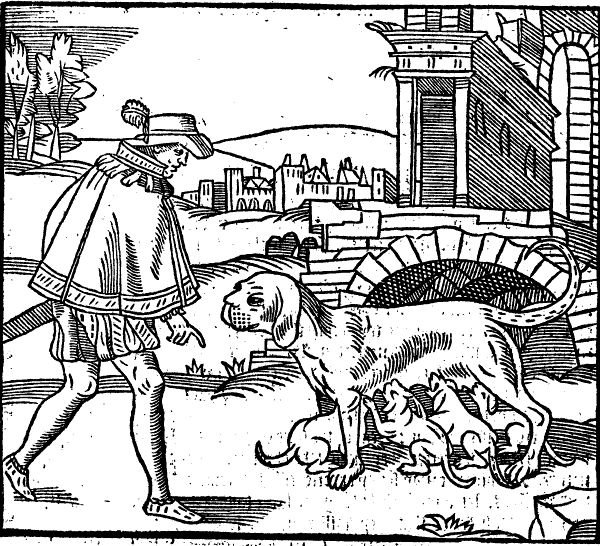
Ok, ok, it wasn't always like that, but there's something very odd about the illustrations in TNAV. Such human eyes for all the animals, and such silly capes for all the humans. The book is essentially a hunter's guide to deer, fox, badger, hare, and otter behavior (thus the essential woodcut of deer sex), a hound-fanatic's guide to hound-raising


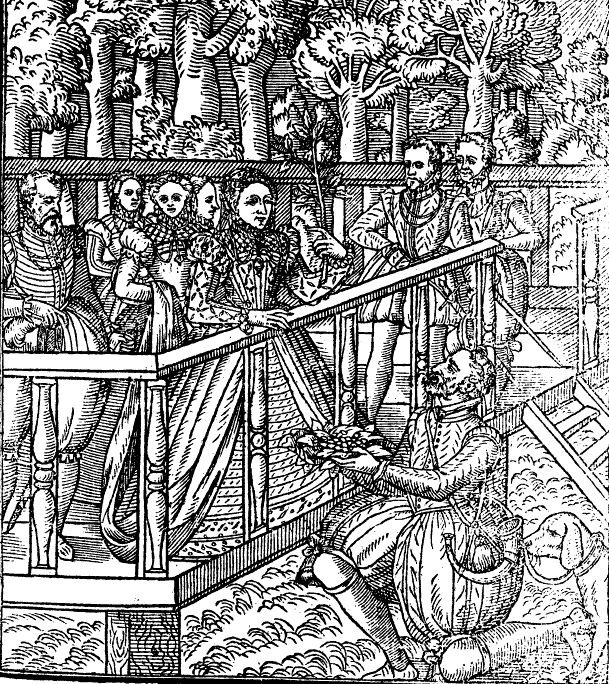
and a brief introduction to the complex mechanisms of the royal hunt. This last element has gotten the most attention from historians, for obvious reasons. The 1575 edition features several illustrations of Queen Elizabeth enjoying a day out in the forest as the central, controlling figure of a hunt (the 1611 edition sneaks James in for Elizabeth, although I get the sense that James didn't stand on ceremony when he hunted). Edward Berry has recently read these illustrations and the strange poems that come along with them as a kind of masque-like performance flattering the monarch, and in the context of TNAV, they certainly appear as such. But the props used in this masque deserve note. Take the following illustration:

Here's part of the poem that explains what's going on, lines spoken, ostensibly, by the huntsman kneeling before the Queen, trying to convince her that his deer -- as opposed to those championed by his competitors for royal favor -- is the one that should be hunted:

For if you marke, his fewmets every poynt,
You shall them finde, long, round, and well annoynt,
Knottie and great, withouten prickes or eares,
The moystnesses shewes, what venysone he beares.

This all seems reasonable enough until you realize what the deer's "fewmets" are. The huntsman in the woodcut is actually holding them up to Elizabeth in a bed of leaves. Yup. Deer droppings. What I love about this (beyond the obvious) is its strange fantasy of royal power. Elizabeth is imagined here as an expert tracker of some sort, able to arbitrate between the competing claims of hunters, each of them holding a pile of droppings up to her and shouting, "Pick mine!" (I showed this image to a cynical friend of mine once, and he said, "Isn't this New Historicism in a nutshell? Showing crap to the Queen and telling her it means something?" Not quite right... but close.) In any case, I hope someone will write a monograph someday on hunting and early modern political power that puts the excrement and rutting at center stage. Berry, Manning, even E. P. Thompson... just not enough grit for me. Or for my main man G.G.

[UPDATE: I decided to run a search for TNAV and discovered, shockingly, that this post is NOT the first item to appear. Check, among other things, this recent essay in EMLS for some actual thinking on the subject... even the fewmets.]

Reading Early Modern Drama

There are roughly 836 plays in Greg's Bibliography of the English Printed Drama to the Restoration.
Of plays 1-100, I've read 4 (ack, I hang my head in shame)
Of plays 101-200, I've read 31 (better, but still embarrassing; and if we counted only those I remember well...)
Of plays 201-300, I've read 26 (ugh, this is not going well)
Of plays 301-400, I've read 23 (sigh)
Of plays 401-500, I've read 50 (better...who knew?)
Of plays 501-600, I've read 6 (shocking)
Of plays 601-700, I've read 1 (I know...and why haven't I read The Prince of Prigs' Revels)
Of plays 701-800, I've read 3 (at this point, no longer a surprise)
Of plays 800-836, I've read zero!

So, on the bright side, it appears I've read about 144 plays first printed between 1512 and 1689, but, sadly, that represents about 17% of all the plays printed during that period. Now, I may have missed one or two here and there, and there surely aren't 144 plays about which scholars of early modern drama routinely write or journals are clamoring to print essays, but the fact remains that this total strikes me as shockingly paltry.

This brings me to what I hope will be a recurring feature here on Blogging the Renaissance: short summaries of plays we like but are rarely read. And by short, I mean short, as in no longer than 1,000 words. And by summaries, I mean mini-essays that explain why we like these plays and why others might like to read them.

But others can play too! In fact, send us your mini-essays about obscure (and not so obscure) plays, and, providing they're not libellous, we'll print them. My goal for this project is a handy resource that I and others can use when it suddenly seems as if I/we need to read, say, A Maidenhead Well Lost or The Costly Whore or Every Woman in Her Humour or Longer Thou Livest the More Fool Thou Art (how have I not read these plays)? Sort of a Karl J. Holzknecht for the twenty-first century.

Now's the time that I should initiate this process with an inaurgural summary, but--surprise, surprise--I'm too lazy to muster the energy to do so. But is this an idea that others would be interested in (or, for the pedants in the house, "in which others would be interested")? Or have I now placed myself in the category of Arch-Nerd of the Renaissance Blogosphere?

Wednesday, April 19, 2006

Scott McMillin Has Died

I've just learned that Scott McMillin has died. I knew him a little bit, and he was a very kind person, generous with his time and his comments on one's work, and very willing to help out junior scholars. His book on Sir Thomas More is one of the best syntheses of theater history and print culture that I've read, and the excellent The Queen's Men and Their Plays (co-written with Sally-Beth MacLean) set the stage for the burst of recent cultural studies of theater repertories. Finally (among the work of his that I've read), his edition of The First Quarto of Othello features a terrific introduction to that play and its textual situation. What I like so much about his work is how clearly he perceives and explains the intricate connections between textuality and performance, whereas many people specializing in one of these two areas seem so often to oppose them. He always combined scrupulous archival scholarship with great critical readings and a wonderful imaginative ability to reconstruct performance possibilities and relate them to broader early modern cultural questions.

He was one of those scholars whom, when I saw that something he'd written overlapped with a project I was working on, I could always count on for illumination. I was therefore especially pleased to find out, when I got to know him the little bit that I did, what a nice person he was.

Tuesday, April 18, 2006

Money to Spend, Books to Buy

I have about $200 for book-buying that will disappear if I don't spend it before I leave Nameless University at the end of the semester for my new digs at the University of the Unnamed.

What should I buy? Any suggestions?

The only two criteria are:

1) they must be academic books somehow related to early modern studies, whether historical, literary critical, or theoretical;

2) they must not be this book:


Help me out. What have you read lately that needs to be on my shelf?

Allergy Medicine

I have allergies, bad allergies. And it's spring, and trees are flowering, and flowers are blooming, and I am sneezing. So I need allergy medicine, badly need allergy medicine. And because I'm at a new school, I have to see a new doctor to get the same old allergy medicine, the life-changing, glorious allergy medicine that I've been taking for the past three years. And because I have to see a new doctor and because I couldn't remember his name and because late March and early April were busy, I put off making an appointment, not thinking that it would be difficult to schedule one at the university's "world-class medical facility" where I have my insurance-prescribed Primary Care Physician. I was wrong.

I have to wait three weeks, three f*cking weeks, to meet with a doctor to get a prescription. THREE WEEKS! The next available appointment is in three weeks! How in God's green earth can a university doctor's office plausibly believe that THREE WEEKS is a reasonable amount of time for patients to wait for an appointment.

And I should point out, the next available appointment date, the one in three weeks, was given to me before I even told the receptionist what I primarily want to see the doctor about. I simply told her that I'd like to make an appointment and she replied that the next available one was in three weeks. And it's not just the allergy medicine that I need. I have an assortment of other ailments I want checked out, one of which (of course) involves fears of a major illness (and "fear" is the operative word; it's probably nothing more than hypochondria and it involves nothing so crazy as worrying that I have leprosy).

When I point this out to the receptionist and when I mention that I'd prefer not to be sneezing constantly for the next three weeks and when I ask if there's any way not to wait three weeks for an appointment, she says, "No, you have to wait," and hangs up. She hangs up on me! I wasn't snarky or angry or loud or anything. She simply unilaterally decided the conversation was over and hung up without so much as saying goodbye.

So, this is how it appears my school's health system works. If I feel that I'm getting ill, I should schedule an appointment three weeks to a month in advance. I'm tempted to setup recurring appointments every two weeks, just in case, you know, which I'll proceed to cancel if I'm feeling fine.

Three weeks! What world are these people living in?

Monday, April 17, 2006

Welcome Carnival-Goers

We've had a bunch of new visitors in the past couple days, thanks to generous write-ups in this month's edition of History Carnival and Carnivalesque. Welcome to all of you. Have a look around and leave a comment or two while you're at it. We're excited to have you here reading the blog, and lurkers are always welcome, but de-lurking is always welcome too!

While you're here, you might enjoy our running series of reports from early modern literature conferences (see the sidebar item "In Sad Conference")--which, incidentally, should amply explain our decision to blog anonymously--and if you want to join in our reading group (see the sidebar item "Read On This Book" for details of our first book), we'd love to hear your thoughts when the time comes.


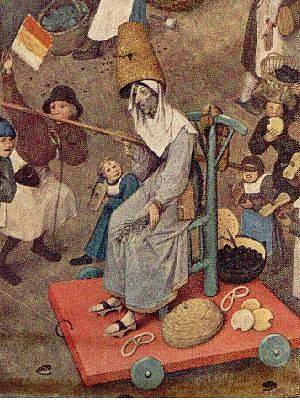
image: Lent at a Carnival, from Breugel's Battle of Carnival and Lent (1559)

Sunday, April 16, 2006

SAA Day Three: "Thrown Into Taint"

I thought about titling this post "Silver Foxes Lookin' for Romance," but I didn't venture into the SAA dance ($20 per person!) and therefore have no first-hand knowledge of the rhythmic gyrations of Shakespeareans of a certain age. The band, however, was apparently composed of former students of Tom Berger's, a few going back thirty years, which proved to be a real draw for some people. What are the odds that Truewit can muster up that kind of long term commitment from his own band of devoted punk/reggae/ska crooners?

In lieu of something truly entertaining, then, I humbly offer up these observations.

The Morning Paper Panels

I went to two panels in the morning, the second of which was amazing and the first unfortunately not. In the first, the speakers went on for too long and without enough humor, organization, or verve. The papers were smart but all over the place with little sense of direction. What made it particularly painful was that I tangentially know one of the speakers and like her a lot. So while I was sitting there wishing I could tell her, "Wrap it up, wrap it up!," I also knew that no one will remember a random unexciting talk a year from now, much less in three or four years. For example, I remember Lauren Shohet gave a great talk at SAA in 2002, and I think James Bulman gave one with audio clips, but the other people I saw then? I have absolutely no recollection of who they were or what they said. And in the speakers' defense, I found it incredibly difficult not to obsess about myself during their talks--over-analyzing my social awkwardness, fretting over my prospects of successfully landing a book contract, replaying various social snubs, etc.--so it wasn't entirely their fault that I had a hard time paying attention.

The second panel, however, was great, which isn't surprising given its all-world lineup: De Grazia ("Staging Thought"), Guillory ("Marlowe and Ramus"), and Stallybrass ("Shakespeare's Desk"). The papers were everything you'd hope they'd be: wildly intelligent, funny, thought-provoking, engaging. Guillory's current project--or, one of his current three--was the one I came away most excited by (as De Grazia and Stallybrass acknowledged, their talks were on material that isn't entirely new). He described his paper as part of a larger study of the figure of the philosopher in the Renaissance and, in it, suggested that the wars of religion during the sixteenth and seventeenth centuries played a crucial role in shaping the perception of philosophers in that period. For example, even though Peter Ramus's writings weren't particularly theological, he nevertheless became an icon of Protestant (and Puritan) thought. In reaction to such polarizing religious forces, philosophers tried consciously to carve out a space for philosophy outside the period's religious discourses, to remove their writings from sectarian warfare (both discursive and military). I'm obviously not doing his argument justice, but it was a great paper and I can't wait for it to begin appearing in print.

As its title indicates, De Grazia's talk addressed the staging of thought, that is, how plays showed characters thinking. It focused mainly on Hamlet (it's part of her forthcoming book on Hamlet) and suggested various props and blocking techniques used to represent characters thinking; it was better than I'm making it sound. Stallybrass discussed how Shakespeare wrote his plays, starting with how he probably would have folded his paper as he sat down to write and then going on to speculate about such issues as the books he would have had near him, the influence of theatrical competition in shaping the subjects of his plays, the need to incorporate props the company already owned, etc. His main point was that looking for utter originality is the wrong way to think about Shakespeare's plays and, more generally, about all acts of writing; instead we should focus on the intertwined concepts of invention and imitation. Even there, though, there are almost no acts of pure invention; we are all a complex distillation of various voices and influences and histories, and to pretend otherwise is to misrepresent Shakespeare and ourselves (again, this summary isn't doing his argument justice). He also offered this small bit of pedagogical advice: it's cruel to tell your students to write about whatever they want; they need limits, so give them some. (As he was talking, my good friend K leaned over and pointed out that writing a dissertation is basically the worst-case scenario of writing about whatever you want.)

Part of what made each of these three talks successful was that they discussed material with which everyone is somewhat familar and then didn't try to do too much with them. To put it in Stallybrassian terms, they weren't trying to be too original. And from an audience member's point of view, it's much more fun and much easier to follow an argument when you know the play than when you don't. The difference between the two panels really drove home the rhetorical challenge of talking about a play few people know.

The Afternoon Seminar

My seminar was a similar experience in contrasting styles. It included two people who were a bit older than the rest of the group. The first was friendly, welcoming, and unknown; the other was disdainful, smug, and famous. The first introduced himself to everyone in the panel as he or she came into the room; the second did not and promptly left as soon as the seminar ended. The first seemed excited by the seminar and to have enjoyed reading the other papers; the second seemed put off that people were no longer discussing topics that he and his cohort wrote about thirty years ago. Oh, and as is probably clear by now, the first liked my paper, and the second did not.

And thank god. I was actually heartened by his resistance because it makes me think there's some substance to my argument, some conventional wisdom to overturn. In fact, and in large part due to him, the panel was a lot of fun because Professor Bitter Fruit's querulousness helped focus the discussion in productive ways. Somewhat amazingly, his mild hectoring didn't cause me to despair but rather rejuvenated me--I came away more convinced than ever that I'm right and that there's a "critical intervention" to be made. I simply wish I could have, I don't know, shook his hand or exchanged a few pleasantries with him.

The worst part of the seminar, though, was when Professor Bitter Fruit trained his sights on Professor Friendly. I don't enjoy watching a genial older man near retirement being aggressively questioned by someone only a few years younger but infinitely more famous. It's very easy to take down someone's argument in a ten-page paper for a whole host of reasons (well, how would you interpret this speech? how come you haven't talked about this idea?), but it's especially easy when a prime weapon is your own superior reputation; it saves you from actually having to support your claims with the same degree of rigor. Professor Friendly held up for a little while, but then more or less caved, and though I wanted to come to his rescue (I actually think he was right), the conversation shifted in such a way that I couldn't really intervene. It left a bit of bad taste in my mouth, so much so I've been inadvertently developing a psychological profile of people who hold the views of Professor Bitter Fruit. (I realize this makes me insane, but, again, I think I'm right and that he was acting like a bit of an ass.)

As I mentioned above, the seminar as a whole I think was very successful. It avoided the problem of many SAA seminars of people making overly general points that head nowhere and for no real purpose. I'm now thinking larger subgroups are better than smaller (in other words, have people comment and respond to four or five papers instead of one or two), and that somewhat aggressive debates about specific issues are more fun than attempts at synthesizing lots of papers. And I loved our seminar leader; she was great, and I think I may have actually made a new friend (at least I hope so).

Some Random Observations

The harshest pronouncement I heard during the conference: "I find your argument compelling but not convincing," which was followed by some rather aggressive questioning. For what it's worth, the questioner seemed to have the better argument.

The funniest phrase during my seminar: someone was talking about a particular play being "thrown into taint." Come on, how can anyone utter that phrase anymore? Do they not watch The Daily Show, which did a hilarious segment on "being thrown into taint" this winter?

Now That's Why I Read for Presses

As I mentioned in my post about the blog redesign, I've had a manuscript to read for a press and a reader's report to write for a couple weeks now, and I finally got to it this weekend. (My goal is to always get these done within a month, having known the horrors of waiting longer.) I've done this about five times now, and there's always a bit of dread when I agree to it. On the one hand, it's an important bit of collegial service, it never hurts to keep the press editors on your good side, and when the manuscript is good, it's an easy way to keep up with new work in your field and get paid (minimally) to do so. On the other hand, what if the manuscript is not good? And what if that not-good manuscript is a first book? Then you have the terrible dilemma of how to respond, with someone's tenure case potentially in your hands. It reminds me of that moment in The Big Lebowski:
BRANDT: Her life is in your hands.

DUDE: Oh, man, don't say that ...

BRANDT: Mr. Lebowski asked me to repeat that: Her life is in your hands.

DUDE: Shit.

BRANDT: Her life is in your hands, Dude.
Dread.

Fortunately, this manuscript was wonderful (and is not a first book). I suspected it would be since it's by a respected scholar whose work I am pretty familiar with and have always loved. And I was right; the book is important, forceful, new, and (thank Jebus) clearly written. In a case like this, it really is fun to read for presses--I now get to enjoy two pleasures, one narcissistic and one other-directed: first, narcissistically, I'm in possession of secret knowledge and can say to people in my field, "oh, you really should read AB's book on that when it comes out ..."; and second, other-directedly, I get to be the (indirect, anonymous) bearer of good news to a colleague. Getting the readers' reports for my book was certainly a highlight of my academic career--#1) job offer; #2) book contract; #3) first publication; #4) diss defense--and it's fun to be on the other end. Of course, since this is a senior scholar, I doubt she'll experience the same mixture of 20% joy and 80% relief that I did.

The only problem with an excellent manuscript is that it's actually much harder to write the report than it is with a problematic one. You can only say "it's great" so many different ways before you start to sound a bit strange. And I hate it when people seem to feel that they absolutely must say something negative in a review simply to justify their critical acumen or to fill up space. But I feel an obligation to treat the manuscript in detail, rather than just writing a single paragraph that says "publish it." Fortunately, I had four or five suggestions that I think actually do matter while in no way detracting from the positive response; and also fortunately, the book is in a subfield I know very well and so can explain why it's great in some detail and in the context of other work and of the history of the subfield, whereas with a manuscript that's more tangential to my own work, it would be more of a struggle.

With these things, you usually get paid either $X or $2X worth of books, and the last time I read for this press I took the latter option, maximizing the bang for the buck. But since I'm moving house this summer, I think I'll save myself some trouble and just take the money. It's a nice academic guilty pleasure, forgoing books for cold hard cash.

Saturday, April 15, 2006

"Inkhorn"; or, Did Nerds Have a Renaissance?

So, this whole vaguely nerdy enterprise, along with some navel-gazing contemplation of my chosen blog handle, has led me to a question: is "inkhorn" the Renaissance equivalent of "nerdy"? Is there some other word? And, more importantly, were there nerds in the Renaissance? Can we find them in Renaissance drama? (Or poetry, but that seems less likely: not in epic, I'm guessing, and not very likely in lyric either. Unless maybe Fulke Greville? He's sort of Sidney's nerdy, studious, over-serious friend... But even if he's morosely conscious of his own lack of sparkle, I'm not sure he intends to perform nerdiness in any real way).

Is the nerd an exclusively late twentieth / early twenty-first century phenomenon? Do you have to have video games and JRR Tolkien to have nerds? What about Gabriel Harvey? The scholars in Love's Labor's Lost are too much the fancy-pants aristocrats to fit the bill ... And anyway, once some ladies pass through, they forget about their books pretty quickly.

There are a lot of ways of being socially outré in Renaissance drama, but I'm not sure I can think of anything that quite qualifies as nerdiness.

(I was very happy once to notice a nail parlor in U.S. City, where I live, that called itself "Outré.")

A little time with the OED seems to indicate that "inkhorn" appears exclusively in the phrase "inkhorn terms" -- which was my own association with it -- and therefore isn't applicable to people. In other words, "nerdiness" was an activity, not an identity, in the Renaissance. (To paraphrase the old argument about "sodometry"). The only exception that I can find is 1 Henry VI, 3.1.101 (in Bevington), where the Third Servingman refers to Winchester as "an inkhorn mate," presumably because he's a member of the clergy. But I'm not sure that gets us very far at all.

More on SAA Day Two

Truewit's characterization of yesterday's lunchtime speech is exactly right--too many sentences in a row beginning with "In 17xx, blah blah blah. In 17xx, blah blah blah." The takeaway point: Philadelphia has a rich Shakespearean and theatrical history. Right. But it could have been worse; we could have been treated to another paean to joys of working with the Bush Administration in bringing Shakespeare to the soldiers [UPDATE: as Hieronimo points out, it may have been the yokels who were supposed to be the program's beneficiaries]. Whatever happened to that program? Why haven't I see the story covered in the MSM or on Fox?

In other news, despite the small annoyances of having many people make eye contact with my chest, there was one delightful moment when I was walking through a semi-crowded room and saw someone's head whirl around to catch my name. Not thinking anything of it, I kept walking but was almost immediately accosted by a certain chipper young Brit who proceeded to tell me how much he likes my work and then--drumroll--proceeded to quote a key phrase from an article I co-authored about five years ago. I almost swooned. But, then, because it's SAA and I'm becoming increasing autistic ("when someone says X to me, I should say Y, Z, or W in reply"--think Christopher Boone, all you A Curious Incident fans), I immediately began to freak out because, though I know who this person is, I've never read his work. I tried to save face by telling him about an article of his that I'm looking forward to reading, which is true, and that his new book sounds great (people were coming up to him as we were talking telling him how well it's selling). But even then, how did I know about his forthcoming essay? Because of a little auto-Googling earlier this week, I discovered that he had mentioned me a couple of times in it (thank you Amazon for the index), which basically means I'm the delightfully self-absorbed kind of guy who only reads articles in which he's mentioned. And since I'm cited about once a year, you can see what kind of bind this leaves me in. On the other hand, Prof. Chipper Young Brit has reeled in another member for his own fan club.

And do keep in mind, this type of interaction is clearly the exception. What happens more typically is that I'm re-introduced to people I've met two or three times, and they almost invariably have zero recollection of me. I'm sort of like Buster Bluth on Arrested Development, who has the remarkable ability to blend into backgrounds and go unnoticed. This happens several times a day at SAA. In fact, there's one Lecherous Young Brit with whom I've been out drinking a couple of times and who has never once remembered me. On the other hand, he did introduce himself, unbidden, to a friend of mine who's a mere grad student, but who is also young, female, and stunning. I'm not sure which is worse: to be noticed by a lech or immediately forgotten by him.

Friday, April 14, 2006

SAA MIA

So, I'm not at SAA this year. Nor was I there last year, in Bermuda, though I took a secret pleasure (not so secret now) at hearing that it rained the whole time. But, despite not being there, I'm going to blog about it anyway.

Now, the usual thing I tell my grad students at State U is that SAA is one of the best conferences because you actually meet people, and you learn stuff in the seminars, blah blah blah, blah blah blah blah. (That's me from my grad students' point of view, sounding like one of the adult characters on Charlie Brown). And I do believe that. But the problem with SAA? Social suffocation. It's all Renaissance people. And not the way RSA is Renaissance people, where you can disappear in the crowd of Professors Dryasdust and Casaubon, who work on German translations of Italian madrigals, without feeling obligated or implicated in any way. It's all English Renaissance, Shakespeare-types. All the time. Parts of it I enjoy. But parts of it generate a prodigious desire to flee. And those parts are especially the receptions and -- the real heart of darkness -- the dance.

Yes, the dance. I hope we'll be hearing from Truewit and Simplicius on that one. A nice photo-essay perhaps? Complete with cell-phone shots of our favorite early modern illuminati getting down. Or, perhaps, up on it. Whatever they prefer.

Ah, SAA. I miss it already.

Where Not to Have Your Next Reception

Apparently the origanizers' original plan was to host the first-night SAA reception in "the Museum" (either Penn's or Philadelphia's, not sure which). But when that proved too expensive, the reception was shifted to the World Live Cafe, which is on the Walnut Street bridge connecting West Philly and Center City, and which is dark and down many stairs and hot and not quite big enough for the SAA crowd. So after a long wait for the trolley to take us to the reception, Truewit and I found ourselves in the academic version of a college frat party: packed in like sardines, waiting in a long line for drinks, with little if any food to be found and lots of people to looking to score (ok, that last bit may not be quite true, or at least is only true in the academic sense, you know, book contracts and the like).

We saw people I hoped we'd see and then left early for an absolutely delicious dinner downtown. Not a particularly exciting first day, nor a particularly exciting first post, but there you have it.

SAA Day One: Look Me in the Eye

If day one of SAA is any indication of the conference as a whole, we will be spending a lot of time in dangerously crowded trolleys. Simplicius tells true: we rode together in the back of what was essentially an open-sided bus from the conference hotel to the opening reception... although reception is probably the wrong word, since it suggests a certain level of welcome. It was more of an expulsion than a reception... 800 deeply unhappy professors stuffed into a room made to hold no more than, say, 500 deeply drunk suburban teenagers. We drank our free beer, then fled. I can only hope the luncheon takes place somewhere other than a mid-sized Chipotle. Mmmmm... cleverly disguised fast food.

Also, people, look me in the eye! It's a bit of a conference cliche -- everyone casually, quickly, looking at everyone else's name tags. It's my one opportunity to feel like I'm being checked out in some way... and I don't like it! I'm more than my (remarkably attractive) name and institutional affiliation! I'm also, um, glasses! I don't know why it's bugging me more than usual this time around. But it is. Look me in the eye when you shake my hand.

Thursday, April 13, 2006

What I'm Not Doing While I'm Redesigning the Blog

While Simplicius and Truewit are off at the SAA (we'll no doubt be hearing from them soon), I've redesigned the look of the blog a bit, in an effort to distinguish it from all the other run-of-the-mill Blogger-template blogs out there: new colors, some new icons, and the new header/logo and footer, which I think are very cool. Let me know what you like or don't like, or if you have any display problems.

Here's what I should have been doing instead of endless fiddling with bloggy code:
  • getting my house ready to show potential buyers (due: tomorrow)
  • reading a manuscript for Cambridge UP, and writing a reader's report (due: about 11 days)
  • revising an upcoming talk, which is drafted but in need of fine-tuning (due: one week)
  • beginning work on the intro I need to write for a Shakespeare edition (due: October)
  • beginning work on the medium-length chapter I need to write for one of those "Introductions to ..." kind of books (due: October)
Actually the summer would be looking pretty relaxing, with only those last two items on the agenda, except that the move from Nameless University to University of the Unnamed will doubtless cause (and already has caused--see item 1 above) numerous delays and sidetracks. Not to mention that I have two totally new preps for the fall semester, one of which is an odd course that's not really in my field and that I will be completely making up as I go along, since the course has only been taught once before at U of U. I know, I know, this semester isn't even over yet, so why am I even talking about preps for fall semester, but this is what happens when one is on leave and procrastinating: hence the blog redesign and the above list.

Tuesday, April 11, 2006

Thomas Carew and Queen Henrietta Maria

Here's a little anecdote from the early 1630s that I hadn't come across before, which may or may not be true:
Queen Henrietta Maria. -- Thomas Carew, Gentleman of the Privy Chamber, going to light King Charles into her chamber, saw [Henry] Jermyn Lord St. Albans with his arm around her neck; -- he stumbled and put out the light; -- Jermyn escaped. Carew never told the King, and the King never knew it. The Queen heaped favours on Carew.
Historic Manuscripts Commission, 7th Report, p. 244.

There's one other little detail worth mentioning: In 1636, William Davenant, servant to her Queen's Majesty, dedicated The Platonic Lovers to Jermyn. Nice.

Academia and the Law

Oh, this is good. The next time someone criticizes my work in print, I'm going to sue him (or her):

John Lott Jr. of Virginia, a former U. of C. visiting professor, alleges that [Steven] Levitt defamed him in the book [Freakonomics] by claiming that other scholars had tried and failed to confirm Lott's conclusion that allowing people to carry concealed weapons reduces crime....According to Levitt's book: "When other scholars have tried to replicate [Lott's] results, they found that right-to-carry laws simply don't bring down crime."

.... Lott acknowledged in the suit that some scholars have disagreed with his conclusions. But he said those researchers used "different data or methods to analyze the relationship between gun-control laws and crime" and made no attempt to "replicate" Lott's work.

In reality, I imagine I'm actually more likely to be sued by someone with plenty of time on his hands than I am to call "my lawyers" (because I have more than one, like all the best litigious students). But I do love the idea of introducing legal damages into Shakespearean criticism. I look forward to the day when the heirs of A. C. Bradley and Northrup Frye begin suing professors and grad students for defamation. And I'd pay to see in court the likes of Frank "I Do Not Mean That All Modern Writing on Shakespeare is Rubbish, Just Most of It" Kermode, Richard "Not a Fallen Liberal" Levin, and Harold "School of Resentment" Bloom fighting the good fight (or not, depending on your perspective) against today's Shakespeareans.

A Thousand Twangling Instruments

Two students of mine came to my office hours yesterday and began to pepper me with strange high school newspaper interview questions: "Who is your hero?" "Do you have any secret talents?" "How many pairs of shoes do you own?" Things like that. Ordinarily, I would have told them to direct all personal questions to my lawyer/PR person, but these being two students that I like -- kind of arts-oriented, smart, hippy-ish dudes -- I first asked them what the hell they were doing. "We can't tell you," they told me. Is this for a website thing, or are you taking a journalism class? "No." Will a lot of people hear the answers to these questions? Sly looks at each other. "Maybe, but not in a bad way." You're not going to ridicule me somehow or make me look like an asshole in public? "No... nothing bad is going to happen." So I answered their questions, except for the hero one, which utterly stumped me. After they got to the end of their half-assed list ("If you could make or abolish any three laws, what would they be?" "Do you have any hobbies?" "What kind of music do you like?"), they started talking about the band they were forming ("kind of a punk/ska/reggae-style thing"), and asked me if I knew any drummers. No, I don't know any drummers. But I did, suddenly, figure out what was up with all the questions.

They are writing a "Punk/Ska/Reggae-style" song about me.

They confirmed, blushing, that this was the case, and that all they had so far was the chorus, which they sang for me in ridiculous off-key hippy dude fashion: "Truewit, whoa ohhh... Truewit, whoa ohhhh..." Cute and petrifying simultaneously. The reggae part is especially petrifying. I think I could handle a three chord rock song, but if there's a space jam in the middle of "Truewit, whoa ohhh," I'm going to be very upset.

Sunday, April 09, 2006

Speaking of the Book of Sports

Here's a longish excerpt from The King's Majesty's declaration to his subjects concerning lawful sports to be used (1633):
It is true that at our first entry to this Crown and kingdom we were informed, and that too truly, that our county of Lancashire abounded more in Popish Recusants than any county of England, and thus hath still continued since, to our great regret, with little amendment, save that, now of late, in our last riding through our said country, we find both by the report of the Judges, and of the Bishop of that Diocese, that there is some amendment now daily beginning, which is no small contentment to us.

The report of this growing amendment amongst them made us the more sorry, when with our own ears we heard the general complaint of our people, that they were barred from all lawful recreations and exercise upon the Sunday's afternoon, after the ending of all divine service, which cannot but produce two evils: the one the hindering of the conversion of many, whom their priests will take occasion hereby to vex, persuading them that no honest mirth or recreation is lawful or tolerable in our religion, which cannot but breed a great discontentment in our people's hearts, especially of such as are peradventure upon the point of turning: the other inconvenience is, that this prohibition barreth the common and meaner sort of people from using such exercises as may make their bodies more able for war, when His Majesty or his successors shall have occasion to use them; and in place thereof sets up filthy tippling and drunkenness, and breeds a number of idle and discontented speeches in their ale-houses. For when shall the common people have leave to exercise, if not upon the Sundays and Holy-days, seeing they must apply their labour and win their living in all working-days?

Our express pleasure therefore is, that the laws of our kingdom and canons of the Church be as well observed in that county, as in all other places of this our kingdom.... Our pleasure likewise is, that the Bishop of that Diocese take the like strait order with all the Puritans and Precisians within the same, either constraining them to conform themselves or to leave the county, according to the laws of our kingdom and canons of our Church, and so to strike equally on both hands against the contemners of our authority and adversaries of our Church; and as for our good people's lawful recreation, our pleasure likewise is, that after the end of divine service our good people be not disturbed, letted or discouraged from any lawful recreation, such as dancing, either men or women; archery for men, leaping, vaulting, or any other such harmless recreation, nor from having of May-games, Whitsun-ales, and Morris-dances; and the setting up of May-poles and other sports therewith used: so as the same be had in due and convenient time, without impediment or neglect of divine service: and that women shall have leave to carry rushes to the church for the decorating of it, according to their old custom; but withal we do here account still as prohibited all unlawful games to be used upon Sundays only, as bear and bull-baitings, interludes and at all times in the meaner sort of people by law prohibited, bowling.

And likewise we bar from this benefit and liberty all such known Recusants, either men or women, as will abstain from coming to church or divine service, being therefore unworthy of any lawful recreation after the said service, that will not first come to the church and serve God: prohibiting in like sort the said recreations to any that, though conform in religion, are not present in the church at the service of God, before their going to the said recreations.

There are a few things I'm interested in here. First, I think it's always hard to fully grasp, and to get students to fully comprehend, just how hard and long people worked in the early modern period. And then they had to spend much of their one day off in church. It's amazing to me that they still had any energy left for vaulting during the few brief hours they had for themselves each week.

Second, the via media aspect of the Book of Sports may not get as much attention as it should. Charles, like James, is carefully laying out penalties here for both recusants/papists and puritans/precisians, and laying out rewards for those who choose neither path.

But most of all, I like the "if you don't go to church, you can't have your vaulting and your archery and your Morris dancing" strategy of convincing recusants to attend services. It's pretty much exactly how my mother got me to go to Sunday school; if I went happily in the morning, I'd be done before 11 am and I'd get to go to Burger King and get a bacon, egg, and cheese Croissanwich™. And when I say "Sunday school," bear in mind that I'm talking about the morning lessons I used to go to on Sunday at the synagogue. So you can see that the deliciousness of the bacon, egg, and cheese Croissanwich™ (and it is delicious) was supplemented by the delicious thrill of transgressing the Deuteronomic laws immediately after my teachers tried somehow to convince me that those laws were not simply the ancient manifestation of Obsessive Compulsive Disorder but had some theological significance. Actually, it's that same supplemental thrill that probably worried those Puritans and Precisians, at least as much as the superstitious May-pole Croissanwich™ itself. And it's also probably why my mother took me to Burger King after Hebrew lessons. She was a fan of the via media herself.

Saturday, April 08, 2006

There is a special providence in the tipping of a cap.

I promise not to turn this into a sports blog (with exceptions made for the Book of Sports), but what with the Passover/Easter season hard upon us, I thought we might turn to St. Beltran for some inspiring words. From today's Times, his thoughts on acknowledging cheering fans after hitting a home run, his first hit of the season:

"Well, I went out," Beltran said. "I just took my time. Like I say, at the beginning, I don't feel like doing it, but I just put myself in the situation of what would God have done in a situation like that. You know, I'm a Christian guy, and after getting booed the first two days, and all of a sudden you come through and get a hit and all of a sudden they want you to go out in a curtain call, I put myself right there and I do believe God would have gone out."


What would God do "in a situation like that"? Well, first off, he likely wouldn't have started the season 0 for 9. If he had, it would have been part of a divine plan leading up to the moment of the redeeming home run itself, the home run he hit for all of us. But the question remains: once God hit the home run, would he then resent the sudden joy of those who had forsaken him during the previous nine at-bats during which he hit predestined ground-outs and the occasional providential pop-fly with runners at first and third? I don't think so. God enjoys a lingering ovation from anyone, regardless of how many times it has been suggested that he is an overpaid drain on the resources of a people/team. Thus, as he humbly points out, St. Beltran acted as a holy man should, forgiving the faithless masses who earn in a year one-half of his daily wage, and gracing us all with his kind acquiescence to our blind adulation. I will burn three Dave Kingman cards in his honor this Pascal season.

Friday, April 07, 2006

Hamlet: not just a cute name for a pig.

So I've been lecturing on Hamlet for the past two weeks, and as a result, I've spent quite a bit of time trying to justify analytical thinking as a potentially useful endeavor to a bunch of students who seem to have been taught in high school that Hamlet is a bit of pussy. As in: "Too much of a pussy to kill himself," according to one delicate flower in the class. (The regional accent here at U State made this a particularly pointed claim.) In fact, I spent much of the time arguing against Hamlet's various attempts to set up thought as the antithesis of action, "conscience" as the antithesis of "resolution." To do so, I had to read Speech 2B for them either as Shakespeare's purposeful display of Hamlet's flawed logic, or as a performance by Hamlet for the various eavesdroppers (thanks, Simplicius, for that one). I can't quite tell whether or not it's a deeply anti-intellectual play. All I can say is that encouraging a bunch of depressive adolescents to think carefully about a play starring a depressive adoloscent (er, 30 year old) who constantly puts down careful thinking seems a bit like a losing battle.

On Pre-Conference Feedback for SAA

This is a silly post. But I have a few thoughts that I want to share about one of everyone's favorite annual academic exercises: giving feedback to members of an SAA seminar. More specifically, here are two types of responses that I've been finding both annoying and amusing.

As everyone knows, essays for SAA typically run from ten to twelve pages. They're short, and they must be short because there are usually ten to twenty of them to read (translating into 100 to 250 pages of academic prose to digest). With papers that length, participants obviously haven't said everything they could say, or probably have to say, about their specific topics.

Therefore, when giving feedback on the papers of fellow seminar members, I try to stay away from comments like "the essay could have done more with Issue X" or "I'm not convinced by your argument." Tense here is everything: SAA essays, and conference papers in general, are always abstracts and brief chronicles of longer projects; they're works-in-progress, not finished products. Obviously every essay could say more about almost anything it contains. So is pointing out that there is more to say about Issue X really necessary?

Likewise, while I may not be convinced by everything in a particular essay, is it necessary to communicate that reaction? Perhaps, but I find these types of comments both more relevant and helpful: "I'm not sure I quite grasp this point, so maybe you could say more about it when the seminar meets"; or, "I found your idea about X interesting and would like to hear more about it when we meet"; or, "I think I see how this might be the case, but I'm not sure I get the connection suggested by the essay." This strategy has the benefit of a) giving us something to talk about for two hours at SAA, and b) giving the author the benefit of the doubt; it assumes she has more to say on a topic; and if she doesn't, it gives her something to think about before the conference.

And if there's some crucial part of the essay that I find particularly doubtful, I'll simply ask a few specific questions about that topic, thereby giving the author a chance to think about the issue I've raised and then to explain why I'm wrong (and lord knows I'm happy to give people that opportunity) or perhaps how she might change her argument.

The other type of feedback I find more amusing than annoying, and it's a move that senior scholars are especially prone to making. It goes something like this: "I wrote an essay on this poem twenty years ago. Why haven't you discussed the same issues in the poem as I did?" Or, better yet: "People used to talk about Issue Y in this play, but you aren't. Why not? Shouldn't you be?" While these types of comments are kind of lazy (I can't think of anything to ask, so I'll respond with a question about what's not in the essay), there are actually glimmers of an interesting discussion that could be had about shifts in critical interests. But instead of opting for the passive-agressive "you're not talking about what I did and you really should be," I think it's more productive and generous to frame it like this: "People used to talk about Y; now people are talking about Z; how do you think these two topics are related? Are they in fact related?" This move at least gives people a chance to think about the critical history of, say, a Shakespeare play and how their arguments fit into that history (and it avoids creating the sad impression that the field has passed by Prof. Sad Senior Scholar).

Blah, blah, blah. I realize all this is elementary and unnecessary. But having read through a bunch of essays and a bunch of questions about those essays, I've been feeling a bit frustrated by repeatedly encountering comments that I find unhelpful and, at times, unnecessarily snarky. Or maybe I'm just being excessively cranky in my old age.

Wednesday, April 05, 2006

Random Non-Renaissance Post

So, while we wait for this exciting three-way photo-finish between Lupton, Shuger, and Halpern to be resolved, I want to share my very non-Renaissance enjoyment of a sign in a store in my neighborhood. The store offers a display of what I would describe as fairly modern, sleek-looking furniture. I can't tell whether it's really boutique-y and designer-y, or just sort of as-if, but at any rate, they're trying for something. Which somehow makes it all the more odd to me that, prominently displayed in the window, they have a sign informing passers-by,

"All items
for sale
for prices."

I like the fact that someone at this store has apparently felt the need to explain to those of us on the street exactly what "store" means, and what we should do about it. I've just read a page in Jonathan Gil Harris's Sick Economies, about how the shop was a new phenomenon in the late sixteenth century. Apparently, in certain parts of Major U.S. Metropolis, it still may be.

I enjoyed Gil Harris's book very much, by the way. So, this turned out not to be a wholly un-Renaissance-y post.

Now, maybe in the meantime we've resolved our suspenseful book crisis.

Tuesday, April 04, 2006

Sometimes we read books

Here at Blogging the Renaissance, it's not all funny stories about teaching, puns on penis and vagina, and snark about conferences. Sometimes we actually do research and sometimes we keep up with work in our field. And now, through the magics of the internets, you can keep up right along with us. We're starting an occasional reading group (very occasional if other obligations like teaching, committees, and of course blogging, get in the way), in which we pick a book and set a date by which we'll have read it, and then we'll post about it. Radical idea, we know. If you want to read the book and join in the commenting fun, so much the better. We'll be thrilled. If not, well, we'll just talk to each other, as we do so often here. We're not proud.

As with our conference reports, you'll be able to find our reading history in the sidebar, for all the future archival historians out there. And for all the authors in our field who are constantly Googling themselves (lock the bathroom door).

For our first book, we're deciding among:
Why are we deciding among these? No real reason. People are talking about political theology a lot, and we all liked Halpern's first book. If you look at the dates on them, you can see how well we've been keeping up with work in our field. Hence the reading group. So those are the options. Feel free to chime in with your choice. Or we'll just pick one. Read along with us. It'll be fun. Just like when you were in kindergarten and the preznit read you My Pet Goat, or as we like to call it, Reading Mastery Level 2, Storybook 1 (1997).

Sunday, April 02, 2006

A Hundred Vaginas

I've found more than a hundred terms for vagina alone.
Now, that's a nice soundbite for plugging a book (or a blog post). This is Héloïse Sénéchal quoted in the Guardian today about her new Royal Shakespeare Company edition of the complete works. She claims this edition will be less prudish than all others in its glossing of sexual slang. Stanley Wells (always in the front of the S-for-Shakespeare section of a reporter's rolodex, apparently), somewhat petulantly says:
If the best thing you can say about a new edition is that it's filthy, it doesn't say a lot. It's a gimmick, an attempt to grab attention.
That's right, a gimmick, unlike, say, titling a book Looking for Sex in Shakespeare, a book that has been pitched to me by more mailings from Cambridge UP than any other I've seen, not that anyone is looking to grab any attention of course, rigorous Dryasdusts as we all are.

I'm happy that Sénéchal will be introducing our undergraduates to more terms for penis and vagina, though I'm sure they can rattle off more than a hundred already. But her class-based explanation for the abundance of bawdy puns in Shakespeare is bizarre:
These were aimed at the working classes who crowded into the Globe in London for their fill of bawdy entertainment .... "Shakespeare is now an institution, and there is an assumption, especially in schools, that he was using high rhetoric. But the majority of his audience were labourers, craftsmen, ordinary people being catered for in a popular way. They were as smutty-minded then as we are now."

Someone needs to brush up her Rochester.